Best things to do on the Lower East Side Visit the oldest immigrant neighborhood in New York, sample a knish, eat a hot dog from Katz’s deli, visit the Lower East Side Tenement Museum, follow up with pickle, hip shop perusing, purchase fabric, finish off at the city’s most amazing sweet shops.
Best time to visit:All year; most hip stores open 12 noon
Length of trip:Put aside 3-5 hours. Satisfies everyone’s interests
Difficulty level:Not too much walking and stroller friendly
Suitable for:All age groups Best places to eat on the Lower East Side Included in blog
Comments:Great for gifts Views:Old New York City and Hip New York
Miscellaneous:Movies featuring the Lower East Side “When Harry met Sally”, “Crossing Delancey”.
Walking Tours: The Museum at Eldridge Street also runs a walking tourthat require booking in advance. The Tenement Museum (click to explore the many options & book) also offers walking tours focusing on a range of topics-foods, history, entrepreneurship, architecture etc.
Advance Planning: The main stop on this trip will be the Tenement Museum. Click to purchase tickets and explore site for hours, tours and walking tours - advance booking is often required. In the summer, avoid visits between 10am and 3pm when it becomes jammed with visiting summer camps.
Subway: Take the F or V subway lines (orange signs) in the direction: Coney Island/Stillwell Avenue) heading downtown to the 2nd Avenue/Houston stop.
Katz's Delicatessan
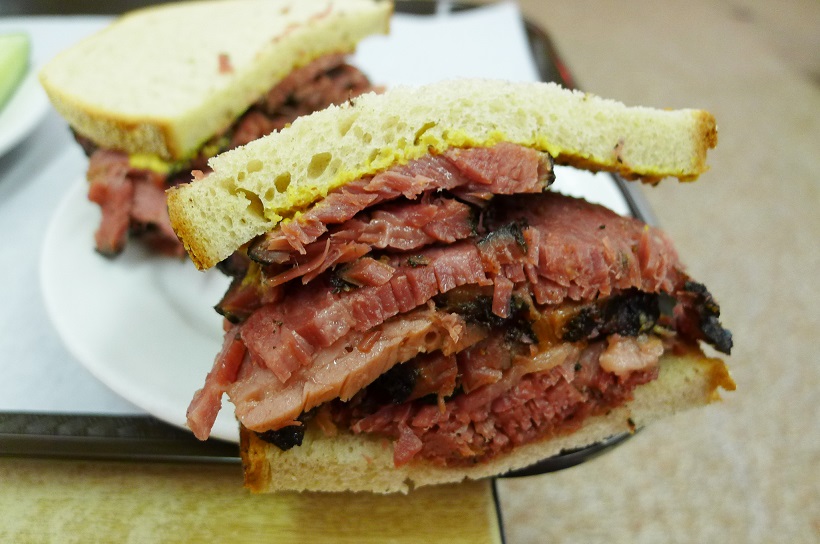
Katz's Pastrami Sandwich
You will pass through a neighborhood that once bustled with activity as immigrants started new lives in the early 1900s. It is estimated that approximately 2 million Jews immigrated to the US between 1881 and 1914 and about 75% settled on the Lower East Side. At one point this was home to the largest Jewish population in the world. Time passed and families migrated to other areas of the city but vivid memories from those days have been passed down through the generations. Living conditions were cramped as the Tenement Museum blog explains: "It was common for a family of 10 to live in a 325-square-foot apartment" and families worked hard to set up businesses. The "Sturgeon Queens" trailer below give a sense of the history of these businesses. It's hard to find the video for streaming but worth a search.
During the last 20 years this area has become "the" place to live and rising real estate prices have tempted many old businesses to sell and as they leave we bid a sad goodbye. It used to be possible to drop into Streit's Mazo factory on Rivington Street and watch Matzo being made but last year the company sold its building and an apartment block is rising in its place.
START:
Yohah Schimmel's Knish Bakery (11am-5pm) at 137 East Houston between 1st & 2nd Avenues - the bakery was established in 1910, started as a pushcart and is the oldest knishery in the U.S.
Recipes for knishes travelled to New York from Eastern Europe with Jewish immigrants. A knish is a dough that is stuffed with mixture of potato and some other vegetable and roasted. It was cheap and filling food and became a staple as families made their way up the social ladder. As communities settled and made money, they migrated to new neighborhoods leaving the bakeries behind until there are now only a very few in the city. Pete Wells the food critic for the New York Times prefers the knishes from Russ & Daughters Cafe - also on you walk.
Katz's Deli (click for hours) 205 E. Houston Street and Ludlow - (“When Harry Met Sally”,"Donnie Brasco", "Enchanted") recently celebrated its 125th anniversary. As you pass walk from the subway stop, you will pass the East Houston shop of Russ & Daughters (click for hours- a NY institution - sells a great T-Shirt and has been modernized by younger family members- the food is excellent and there's a sit down cafe farther along the walk). Katz's is famous for their Pastrami Sandwich. Jewish Delis were a vibrant feature of New York city living until the 1980s. A few remain and Katz's has been listed among the best of its type in America. If you haven't tried it the owner of Katz's suggests what to order in the video below. The lines to eat here these days are long comments from people living nearby: Avoid around the Christmas season and weekends unless around 9am. Monday - Thursday best before 11am or after 2pm. Il Laboratorio del Gelato at 188 Ludlow Street at East Houston for incredible ice-cream.
Follow Ludlow Street south towards the Tenement Museum (click for visit details) at 108 Orchard Street. See map. On Ludlow you will passT R Crandall Guitarsat 156 Ludlow street. Continue toEconomy Candy (click for holiday hours) open 7 days a week 12pm- 5pm at 108 Rivington Street between Ludlow and Essex. You'll find an incredibly colorful room lined with all types of candy floor to ceiling. Great for gifts. Continue south on Ludlow, cross Delancey Street and walk 1 block west to Orchard Street to the Tenement Museum. While you are waiting for your tour you can browse the wonderful shop that stocks a wide range of books about New York.
Economy Candy 108 Rivington Street
Before or after your Tenement Museum visit there's a wide range of shopping choices and diversions possible. Russ and Daughters Cafe (click for hours they are only open for breakfast & lunch at 127 Orchard Street between Delancey and Rivington serves excellent - or try what has been listed as the best Chinese restaurants in New York City, Congee Villageat 100 Allen Street. New York Magazine raves about this restaurant and recommends: "Order everything- especially the bok choi, chicken & mushroom congge, and salt and pepper shrimp" .Vanessa's Dumpling Houseat 118A Eldridge Street is know for for some of the best NYC dumplings. Below are post lunch/breakfast detours.
Check out the interesting places close by:
Hua Mei Bird Garden at Sarah D. Roosevelt Park (see map). The sanctuary was set up in1995 with the help of the parks depart. Chinatown inhabitants bring their song birds out to the park which gets quite busy on weekends.
Zarin Fabrics
Ramon Tailorat 110 Forsythe for a peek in the window or for maybe for alterations this nice story in New York Magazine led to his further discovery. Yokkoyama Hat Market at 116 Eldridge sells cool and amazing hats. Zarin Fabrics(weekdays and Sundays - click for hours) at 72 Allen Street Street. Don't be deceived - behind this not too exciting store front and upstairs is a nice collection of fabrics and some bargains.Orchard Street was once famous for these stores. Pilgrim New York, at 70 Orchard Street stocks vintage clothing from Japan & Europe.
Walk East towards Essex Street, on the corner of Essex & Grand you will find The Pickle Guysat 357 Grand Street. They have great pickles and goofy, one-of-a-kind t-shirts for sale. Pickle vendors were common in this area a very much part of the deli culture. Sadly this store is now one of the few remaining.
Essex Market88 Essex (also good for lunch, snacks, or breakfast - Monday - Saturday 8am-8pm & Sunday 10am-6pm)
Last stop for those with energy and looking for something essentially New York isOnly NYat 176 Stanton Street - great selection of New York clothing and accessories. Check for opening hours - most days 11am-7pm.
A visit to MoMa - the Museum of Modern Art - best places to eat, things to do & see nearby. Visit MoMA, eat lunch there, explore a mega Lego Store or American Girl Place, step into Saint Patrick's Cathedral, cross the 5th Ave and look up at the Rockefeller Centre - whizz up to its roof & find a playground in Central Park or visit the Fire Department of New York Fire Zone - explore a firetruck, meet real firemen and learn about fire-safety, play games at the Apple Store and finish off in Central Park, enjoy afternoon tea or caviar and champagne and head off to the world's biggest diamond trading arena.
Best time to visit:All year - views best on clear days in summer.
Length of trip: Minimum 2 hours
Distance: Short
Suitable for:All age groups and especially FDNY Fire Zone for kids
Other Comment:Keep the museum visit short with kids
Nearby eating: Suggestions throughout blog & marked on map
Miscellaneous: Make sure to purchase the great leaflet in the gift shop at the top of Rockefeller Center that locates famous buildings within your view. Sunset is a great time to visit.
Events: Click forCalendar of events in Central Park or check my blog on Central Park. Skip Wollman Rink & Central Park Zoo on this outing, both would involve a great deal more walking - best to keep these for a Central Park focused trip. The park hosts free summer outdoor movies, concerts and opera. Shakespeare in the Park is a series of free summer performances held at the Delacorte Theater there. Attending requires forward planning.
Nintendo Store FDNY Fire Zone check out their website and call to ask when the best time to visit is. www.moma.orgMoMa website for hours and location. Free for under 16s! Open Mondays when most museums closed.
https://www.moma.org/visit/discounts Check out parking, discounts and restaurants offering discounts by showing a MoMA ticket - they are all good. More listed at the end of the blog- including a dim sum happy hour on weekdays!
Afternoon tea spots: all require booking in advance - click on each for link for contact details.
START: The Museum of Modern Art at 11 west 53rd Street between 5th and 6th Avenues, for hours check www.moma.org . Not only is the building beautiful – but so are the street views framed by the windows. To avoid crowds go early. There is always something of interest here for all age groups.
Good for short visit, avoid the recorded tour and find the shiny green helicopter suspended from the ceiling. It can be seen from every floor. The third floor is home to architecture and design department and displays everything from a flight arrival and departure board to sports cars, a motor cycle, cool chairs and appliances. The MoMa art collection is wonderful and very appealing to children. The museum has a great store and two good, kid friendly cafes/restaurants. Or in summer sample what has been voted the best ice cream in New York City from Il Laboratorio del Gelato in Sculpture Garden. For and expensive but gourmet experience, try a quick lunch sitting at the bar at the Modern – pricey, well rated for its food, a bit more up-market but kid friendly. Or exit and head to a restaurant on the the MoMa list of restaurants that offer discounts if you show your ticket. Discount lunch with ticketor continue on your walk. More suggestions at the end of the blog.
Rockefeller Center:Builders lunch break
Click on the attached Smithsonian Magazine story that verifies the authenticity of the photograph link -
Though this photo was put together for publicity purposes, these men did not use safety harnesses and walked way above the city harness free every day. Worker saftey laws only changed in the 1970s after the World Trade Centers were completed. These workers were admired and known to the public as the "sky boys"
A history of how sky scrapers were built in NYC.
The entrance to the Rockefeller Center is at 30 West 50th Street between 5th and 6th. The elevator ride is super fast. The building was completed in 1933, took 3 years and cost $100 million. Following the Wall Street Crash of 1929 was privately funded by John D. Rockefeller. Views are spectacular especially the ones of Central Park.
Rockefeller Center
Make sure to purchase the leaflet that names the buildings within view. The NBC studio tour is always a giant hit with kids especially since it ends in a fairly large sweet shop.
ORVisit the FDNY Fire Zone at 34 West 51st Street between 5th and 6th Avenues. click on the following link FDNY Fire Zone for hours- in summer it might be worth calling ahead because of visiting summer groups or make a point of holding off your visit until 3pm. Also book the fire simulation presentation in advance - recommended for 5 years olds and up. It's an educational adventure. Meet real firemen and try on their gear and protective clothing. The Fire Zone opens at 9am every day except Sunday when it opens at 11am.
To burn off energy try the playground in Central Park at 59th and 6th. On rainy days look for the mega Lego Store at 5th & 51st or explore the stores in the basement. American Girl Place is around the corner on 51st between 5th & 6th. Afternoon Tea here needs to be booked way in advance. Nintendo New York is on 48th between 5th & 6th.
For nearby shopping - the MoMa store, or walking up 6th to the Time Warner Building at Columbus Circle at 59th and Broadway– Williams Sonomo (great kitchen stuff), J Crew and various bag, designer and a new toy store called Art Camp Stores at Time Warner
Or walk in the opposite direction - south to 47th between 5th and 6th Avenue will bring you to the New York City Diamond district. 90% of the diamonds that enter the United States pass through New York City and there are over 2,600 businesses in the district (see http://diamonddistrict.org/) - the short film below provides a nice background before visiting.
Lego Store at Rockefeller
Best dining options nearby:
Otherwise walk east towards 5th Avenue to 58th Street for afternoon tea at the Plaza Hotel in the spectacular Palm Court (click for hours and reservations) and here for Menus across the street is the Apple Store. A little further down 5th are Bergdorf Goodman and New York classic expensive but interesting department store. A very cool place for a drink is The Four Seasons designed by I.M. Pei on 57th between Park and Madison. Tiffany’s is on the corner of 57th and 5th. Or continue on down 5th to St. Patrick’s Cathedral, Sacks 5th Avenue and the American Girl Place (51st between 5th & 6th). Or if you are feeling like a rest take an expensive but traditional and unforgettable (for kids) carriage ride through Central Park.
Russian Tea Room
An alternate New York favorite for afternoon tea is the Russian Tea Room at 150 West 57th. between 6th and 7th. Make sure to reserve beforehand (Russian Tea Room link). The American Girl Doll Store also offer lunch and afternoon tea but booking in advance is a must. (American Girl Place link).
Petrossian (expensive) for coffee and caviar gifts at 182 West 58th between 6th and 7th
Dim Sum Palace click for happy hour and menus (family friendly, 50% off at happy hour, weekdays) at 28 West 56th Street. Ippudo - (mid range & casual) Some of the best ramen noodles in NYC at 321 West 51st between 8th and 9th - no reservations arrive at 11:45 am and you won't have to wait -great food Marea - (expensive & not too casual) considered the best Italian restaurant in NYC at 240 Central Park South between 7th and 8th - lunch is a less expensive option to sample the menu and without reservations you may be luck to get a seat at the bar is always fun.
Fast food: see the google map below for nearest Chipotle, Shake Shack
Classes around NYC - Can search and filter by "single session" -great for rainy days and some offbeat ones- (two hour shoe making, glass blowing, stage fighting). Lots of cooking and craft classes. Also lists NYC experiences (sailing around Manhattan) and tours
The Apollo Theatre - 125th Street Btw Frederick Douglas Blvd & Adam Clayton Powell Jr Blvd. Amateur Night At The Apollo - a talent competition. Contestants brave cheering and booing.Ella Fitzgerald, Lena Horne and Billie Holiday launched their careers here. Fun evening. https://www.apollotheater.org/amateur-night/
Monkey Bar -54th Betw Madison & Park has been around since 1936 and is known for its good burger. The setting is retro and chic with red leather booths, low lighting and wall murals. Takes you back to earlier times in the city. https://nycmonkeybar.com/
Lincoln Center calendar of events: (New York Philharmonic, American Ballet Theater, Jazz, at Lincoln Center, Lincoln Center Theater and Lincoln Center Film Festival- good for booking for holiday events and Met opera: (lots of events for kids)
Seaport Cinema (Various): Seaport Cinema on The Rooftop at Pier 17 https://theseaport.nyc/seaport-cinema/
Paramount+ Movie Nights in Brooklyn (June 7 - September 5)Fort Greene Park, Prospect Park, McCarren Park and Coney Island Beach for free, beginning at sunset. https://www.bkmag.com/movies/
Brooklyn Bridge Park Movies with a View (July - August):Movies take place Thursdays in July and August at Pier 1 Harbor View Lawn. Doors open at 6:00 PM, movies start at sunset.https://brooklynbridgepark.org/event-series/movies-with-a-view/
Movies Under the Stars (through September): The Mayor’s Office of Media and Entertainment and NYC Parks bring more than 150 film screenings to parks throughout the five boroughs. https://www.nycgovparks.org/events/movies-under-the-stars
Riverside Park
Riverside Park Summer Eventsincluding films, workout sessions etc. July 5 to August 16. Seatig opens at 6:30pm and movie begins around 8:30pm.
Time Square Live TSQ Live invites hudreds of artists, performaers and producers to share their work - 80 free, open air events are lined up from DJ sets and live concerts to dance workshops and art activities. Participating insitutions include Carnegie Hall, Jazz at Lincoln Center, Alvin Ailey, Elsewhere, Soul Summit, Street Lab
Bric Celebrate Brooklyn
Celebrate Brooklyn The City's longest-running, free, outdoor performing arts festival at the Lena Horne Bandshell in Prospect Park
Hudson Classical Theatre Company promises the complete abridged works of Shakespeare this summer on the Patio of the Soldiers' and Sailors' Monument at West 89th Street & Riverside Drive. Thursday through Sunday 6:30pm.
Explore the campus of Columbia University, climb up into the eves of the largest Gothic Cathedral in the world, discover the history of Bebop and eat Sunday jazz brunch in the place it all started. Learn about the Beat movement and walk the neighborhood, make your way down to the Hudson River to try swinging on the traveling rings.
Best time to visit: All year
Time: Minimum of 2 hours
Distance: Short
Subway Stop: Local no.1 train to 116th Street & Broadway. Walk through the gates of Columbia University
Suitable: All age groups
Eateries: If you haven't booked brunch at
V&T Pizza -Amsterdam btw 112th & 113th Streets. Since1949 -revered by the Columbia community
Toms - 112th & Broadway - diner made famous in Seinfeld as Monk's Cafe
Hungarian Pastry Shop at 111th & Amsterdam another local favorite for desserts.
Absolute Bagels a bakery and cafe on Broadway at 108th Street
Massawa -Ethiopian restaurant-121st Street & Amsterdam. Spicy delicious food & my young nephews loved the fact that had to eat with their hands. https://www.massawanyc.com/
Insomnia Cookies on Amsterdam - between 110th & 111th Streets
Levain Bakery (best cookies) - Frederick Douglas Boulevard between 116th & 117th Streets
Miss Mamie's Spoonbread Too - 366 110th Street (at Columbus Avenue). Good soul food
In the summer time try the Ellington in the Park, in Riverside Park around 105th Street - lots to do for kids and adults. Relaxed outside seatings with front row view of the traveling rings - also fun to try https://www.theellingtonny.com/location/the-ellington/
Events & Advance Planning:
Book & reserve in advance where possible.
Columbia University offers guided historical tours that require advance reservations and a downloadable self guided tour (see link) .
Check out the Cathedral's events calendar - there's always something going on-
For the Feast of St. Francis of Assisi, the church opens its doors (sometime around the beginning of October) to welcome a procession of as many as 3,500 pet lovers and their animals to be blessed. The processions have included, cows, elephants, camels, horses, boa constrictors, cockroaches, camels and bulls. Guided tours - pre book the tours that include the Vertical tour (climb up 124ft into the eves of the Cathedral), a Halloween Crypt tour, Highlights and a tour of the grounds. Concerts celebrate the holidays and musicians from around the world come to play here - concert calendar.
The Blessing of the Animals
At Halloween there's a showing of the silent movie Nosferatu accompanied by the booming Cathedral organ. " Seats closes to the action are for the bravest at heart, who may find themselves directly confronted with the hooked nose of a demon, a mossy nails witch, or the bulging, flushed cheeks of a ghostly manchild."
Beat Generation in New York: A Walking Tour of Jack Kerouac's City by Bill Morgan
START:
1. 116th & Broadway. Columbia University was as granted a charter under British rule in 1754, was founded as "King's College" and originally located at Trinity Church downtown. In 1775 Myles Cooper who was a royalist and president of the college at the time was chased by patriots out of the city and boarded a ship bound for England. During the American Revolution the college was seized and occupied by the British in 1776 and used as a hospital and classes were suspended. Many students were supportive of the occupation but some includingAlexander Hamilton, John Jay, Gouverneur Morris and Robert Livingston became part of the founding of America. John Jay and Hamilton re-opened the college in 1784. The campus opened in 1897 as Columbia College at its current location.
Famous graduates include Richard Rogers, Oscar Hammerstein, Ira Gershwin, Alexander Hamilton, Alicia Keys, Joseph Campbell, Art Garfunkel, J.D. Salinger, Alan Ginsburg and Stanley Kubrik. Four US presidents graduated from here - Barack Obama, Theodore Roosevelt, Dwight D. Eisenhower and Franklin D. Roosevelt.
2. Walk through the campus and exit at Amsterdam Avenue - the Cathedral of St. John the Divine is located at around 112th Street and Amsterdam Avenue. According to the website (https://www.stjohndivine.org/ it is the largest cathedral in the world and seats 5,000 and is not complete. Construction started in 1892 and stopped with the outbreak of World War II when church leaders decided the community needed more support. Work was resumed in 1982 though spending policy continues to place an emphasis on supporting the local community. The central portal carvings around the entrance were completed by British master carver, Simon Verity who visited between 1988 and 1997. The figures are based on local people and friends of Mr. Verity. South of the Cathedral is the Children's Sculpture Garden.
The Cathedral offers artist residencies and has attracted people like Judy Collins and Paul Winter as well as the high wire artist Philippe Petit, who in 1974, took an unauthorized tight rope walk in the early hours of the morning between the two towers of the World Trade Centers. The walk took 50 minutes, 1,,350ft above the ground and he was arrested immediately after. Petit during his work at the Cathedral in 1982, walked rope 150 ft above the ground crossing Amsterdam Avenue to the Cathedral.
3. This area is also in the neighborhood of where Bebop, a movement that revolutionized jazz, was developed - at Minton's Playhouse at 206 West 118th Street - the style evolved in the 1940s as a reaction to commercially driven escapist music of the Big Bands of the World War 2 era. Amongst its originators were - Charlie Parker, Dizzy Gillespie, Thelonius Monk and Max Roach. Charlie Parker said he was "bored with the stereotyped chord changes that were being used". The musicians started to jam at Minton's Playhouse. The sound they created was free form and spontaneous. In these sessions Parker and Gillespie combined their technical ability with their deep knowledge of musical theory. Bebop is about individuality and is characterized by improvisation and harmonic complexity. At Minton's people came to listen rather than dance - jazz switched from being escapist and care-free entertainment to something much more visceral and deep. The new style required artistry and virtuosity. Minton's was also frequented by Ella Fitzgerald, Duke Ellington, Benny Goodman, Billie Holiday, Louis Armstrong, Miles Davis and Sarah Vaughan.
Jimmy Heath talking about Bebop
The ethos of Bebop spread to literary creatives and inspired the Beat movement which was incubated in New York City at Columbia University when Allen Ginsburg, Lucien Carr, Jack Kerouac, William S. Burroughs, John Clellon Holms and Herbert Hunke met as students in the early 1940s. The movie below explains the link with Bebop.
Context of Bebop and Beat
4. Walk back to 110th Street & Broadway
5. If you walk south, down town on Broadway - make a right at 110th on and walk until you reach Riverside Drive at 105th Street. 330 Riverside Drive is a mansion that was purchased in 1905 by Robert Benson Davis the founder of Davis Baking Soda (still around today). Not long after, Davis in his who was in his early 70s, sued his much younger wife for imprisoning him and attempting to access his fortune. She had him locked in a room and controlled his mail and food. He eventually devised an escape by addressing a letter to a friend and throwing it out the window. It was found and delivered and not long after, Davis filed for divorce having escaped to California. The case became sensational news and strangely the couple returned to living together at 330 Riverside. Jennie Weed in fact died before her husband and the house was eventually passed on to their daughter and her husband.
Finishing off the day: Make your way down to Riverside Park off 105th Street at Riverside Drive. The set of Traveling Rings here over look the Hudson River and there is great people watching on a warm evening if you don't feel up to trying them. The Ellington Cafe is open during the summer months and if its a nice evening you can't ask for more. At the same location there is soccer, soft-ball and table tennis nearby as well a dog run with lots of benches around 106th Street at the upper level of the park (ask anyone for directions).
SoHo -became a center of city industry during the late 19th Century. Fifty years later the large commercial spaces were falling into disrepair. During 1960s, 70's and 80's artists took up residence here and they partied, collaborated, performed, played music and turned the art world upside down. SoHo is where the minimalist and American modernist art movement was focused and three small museums in the area provide a glimpse into its vibrancy. Finish at McNally Jackson book store at 52 Prince Street to find the books written by these creators.
Best time to visit:All year at but check websites for opening museum opening hours
Length of trip: As long you like
Subway Stop: R train to Prince Street and walk south on Broadway to Spring Taxi: Spring Street and Broadway
Suitable for:All age groups interested in art
Nearby eating: Balthazar for very good brasserie dining (off Broadway on Spring Street),Alidoro - for old timeItalian sandwiches (105 Sullivan Street).
There are some great burgers to be had in this neighborhood at Balthazar (listed above), Black Tap Craft Burgers and Beer (529 Broome Street) and Fanellis a New York icon that has been around for decades (94 Prince Street). Mexican - Cafe Habana (17 Prince Street). Lighter fare good salads etc- Jack's Wife Freda 224 Lafayette or Cipriani (376 West Broadway) Advance Planning: Check museum websites for opening hours. Since most are small some require online booking in advance. To reserve a table for dinner or check the menus Balthazar Restaurant
For art galleries to visit in the area click on the following link: New York Art Galleries Soho The Whitney Museum, The Guggenheim and MoMa also house and exhibit works from this era.
Documentaries about the art scene:
"Herb and Dorothy" a documentary directed by Megumi Sasaki
"The Artists Studio: Donald Judd" directed by Michael Blackwood
"The Troublemakers: The Story of Land Art" directed by James Crump
"The Karamazoffs: A walk on the SoHo Years" directed by Juan Gamero and Carmen RodrÃguez Reading: "I think I'm built for this kind of life" by Christina Patterson, The Independent
SoHo: South of Houston- As you walk north on Broadway onto Mercer and continue to West Broadway. There are 250 cast iron buildings in the city and the majority are in Soho. Fronting buildings with cast iron became popular in the late 19th century. Cast iron was a cheaper and a more lasting method for making decorative facades. Broken pieces could be easily recast and it allowed for quick construction. The strength of the metal allowed for larger windows and higher ceilings.
As textile manufactures left after World War two, the area began to face dereliction and Robert Moses the great New York City planner, was ready to demolish the buildings to make way for a highway. Seeing an opportunity for bargain rents, artists began to move in during the 1950s.
The early 20th Century modernists movement had already started to turn its back on traditional concepts in relation to art. By the 1960's there was a rising rebellious mood seeking a new vision that questioned accepted conservative values. The Vietnam War served as a further catalyst for change.
In the early 1970's the appeal of low rent and giant light filled space that could be used as both for living drew artists to SoHo. Residents simply cleared industrial debris and ignored the lack of kitchen or bathroom. It was possible to purchase a whole building at that time for $80,000. By the 1980s gallery owners moved in and the area became trendy. A whole new minimalist, absurdist, a experimental art movement had been spawned.
American painter and photographer Chuck Close lived in a loft on Green Street between Canal and Grand during this time. He said he "lived with no heat, with plastic on the windows so you couldn't see out." He said it was a time when ... "you wanted a purging of all associations of art historical associations as much as possible and as much as possible separate yourself from what was being made in the loft next door. So this is diversity or pluralism of the time allowed for both minimal painting and pop art in a sense to reign simultaneously, at the same time conceptual works, and earthworks, and various kinds of realism.."
Swedish born pop artist Claes Oldenberg came to New York in 1956 and eventually settled in SoHo. He said it was "like a college campus; you just walk out on the street and you bump into someone" -like Montparnasse in Paris an area of artists cut off from the rest of the city.
Jonas Mekas talking about the role of George Maciunas in developing SoHo
George Maciunasand the Fluxus Movement (1939-1978) was labeled "the father of SoHo" by the New York Times and was founder of the Fluxus Movement. His ambitions was to free the world of art and replace it with Fluxus -art that could be created by anyone, anywhere. He was against the concept of museums and saw no value in the idea that education is required to understand art. Maciunas said Fluxus was a fusion of " Vaudeville, Cage and Duchamp" and was a loose collective of artists, musicians and designers. Maciunas did not believe in ownership, never signed any of his work and if pressed to define Fluxus he liked to play recordings of geese honking or dogs barking. He developed the concept of a 3-day Flux-Olympiad, with soccer on stilts, balloon shot-put and slow speed bicycle races. Though Maciunas died of cancer in 1978 and never lived to stage the event, the Tate Gallery in London held an Flux-Olympics in 2008.
Yoko Ono was a member of the movement and her bed-in with John Lennon was a Fluxus influenced performance. Laurie Anderson was also very influenced by Maciunas' ideas. He collaborated with and influenced the work of pop artist Andy Warhol.
Maciunas, who had trained as an architect was also interested in urban planning and came up with the idea of co-op spaces for artists where they would share work and living spaces. This he called the Fluxhouse. With an initial grant of $20,000 form the National Foundation of the Arts and the J.M. Kaplan Fund he set about purchasing buildings. According to the George Maciunas Foundation "By offering shares at about $1 per square foo and charging minimally for renovation, he was able to take in enough deposits to make the $50,000 down payment". In all he created 11 co-operative units involving 17 buildings creating a "Fluxcity" a "collective estate which offers the space for art to flourish"
credit: The Tate Maciunus' fluxus olympiad
Jonas Mekas, died in 2019 and is considered a founding father of experimental film. His spirit and energy shaped the SoHo community of the 60's and 70's. Mekas was one of the first artists to purchase space in one of the first Maciunas artist co-op spaces in SoHo at 80 Wooster Street. Maciunas' idea appealed so he fundraised to purchase the space and establish Cinematheque I with the backing of one of his wealthy supporters. Cinematheques as Mekas planned would be " a place where the public will have to take chances with new artists and new works of estblished artists" ... "this will be our workshop our testing ground where anything goes". It became a center for festivals and screening but frequently faced financial difficulties. Mekas eventually established Anthology Film Archives where he showed experimental film and video and staged Fluxus events and concerts by Yoko Ono and John Lennon.
John Cage 1912-1992once said " I don't like meaningful sound. If sound is meaningless, I'm all for it" . Be believed composers should free themselves from conventional musical language to open the doors of creativity to minimalism, and experimental music and performance art. His work inspired debate and at times incited fury - sometimes audiences walked out. Critics had a hard time accepting the range of instruments he used such as flower pots and cow bells. Cage whose father was an inventor was never deterred and sought out innovation. His musical training was varied until he persuaded Schoenberg. Cage moved to New York City in 1942 and eventually met up and worked with Merce Cunningham who he ended up living with until his death They collaborated and toured on ground breaking new performance pieces.
John Cage performing "Water Walks"
Beach Birds - choreography Merce Cunningham, music John Cage
Merce Cunningham established the Merce Cunningham Dance Company in 1953 and revolutionized the approach to dance. With John Cage ee collaborated with a number of artists including Robert Rauschenberg, Jasper Johns and Andy Warhol.
Pop Art was also underway. Roy Lichtenstein while working as an professor of Art at Rutgers University in 1961 was producing large scale comic strips. Swedish born artist Claes Oldenberg settled in New York City in the 1950s and set about creating art from everyday things..Andy Warhol was to follow and add a social and rock music to his area of interest.
Claes Oldenberg talking about his work
Whitney Museum short set of interviews about Andy Warhol
Warhol's interest extended to music and he took on the management of the Velvet Underground. Jean Michel Basquiat, Philip Glass, Laurie Anderson, Twyla Tharp and David Bowie mixed and collaborated through the 70s and 80s.
John Cale interviewing himself about the Velvet Underground and Andy Warhol
Andy Warhol's screen test of Lou Reed
"Jonas Mekas talks about Andy Warhol's 8 hour movie "Empire" Heni Talks
A glimpse of Basquiat
Walter de Maria a sculptor influenced by the San Fransisco jazz scene of the 1950s moved to New York City in 1960. He is known for his minimalist and conceptual art and environmental installations (for more information on the movement watch the documentary "The troublemakers: The Story of Land Art"). He also had a sideline interest in music. Having learned how to play the drums as a kid Walter became the drummer for a band called the Primitives in 1964. The other musicians were Lou Reed and John Cale. Not long after he left the group, it was taken up by Andy Warhol and renamed The Velvet Undergound. The band was too serious for his liking and he was quick to move on.
"...And it was very tiring to bring all the drums around, you know, and then after playing all night, you couldn't do anything during the day and this was a period of months. I thought, are you going to play or are you going to do the sculpture? You know, are you going to be an artist or a musician?
(transcript of the interview with him done by the Smithsonian Archives of American Art - a really interesting read where he talks about his life and his influences:
He continued to play drums for a less ambitious and maybe more offbeat band - The Druds. Friends (also artists) LaMonte Young, played saxophone, Larry Poons was on guitar, Patty Mucha (married to Claes Oldenburg) was lead singer and Jasper Johns wrote lyrics. Andy Warhol periodically sang back up.
Later in life he maintained a lower profile and described the art scene in New York as "a hundred people pillow fighting each other blindfold and swinging knives instead of pillows". De Maria died of a heart attack in 2013 and left behind an expansive collection of work - there are two installations in this neighborhood. The New York Earth Room was created in 1977 is at 141 Wooster Street and The Broken Kilometer - created 1979- closed for the summer) is at 393 West Broadway, Check the links above for hours.
Gordon Matta-Clarke lived in SoHo and set up the restaurant Food. In this Whitney Museum short film, Jane Crawford, Matta-Clarke's wife talks about his work and early death at the age of 35.
Jeu de Paume short film explaining the work of Gordon Matta-Clarke
George Condo working in his Soho loft. Condo was part of the 1980s Soho artist scene
The short film below shows the seemingly arbitrary path many artists followed. "Dickie" Landry has had exhibitions and performed at major museums and venues. He has performed with Philip Glass, Paul Simon, Talking Heads, Bob Dylan and the Band and Robert Plant.
Donald Judd -Visit his studio and home at the The Judd Foundation at 101 Spring Street can be visited by booking an appointment online. See link above. Judd is considered to be one of the most important artists of post war America and has been described as a minimalist, however, he did not agree with the classification and preferred to refer to himself as a minimalist. MoMa will be holding a retrospective of Judd's life work in 2020 and describes his artwork as "untethered from the traditional frameworks of painting and sculpture, focusing instead on an investigation of "real space" or three dimensions, using commercial materials and an emphasis on whole unified shapes..."
Judd purchased 101 Spring Street as his home and studio in 1968 for under $70,000. His daughter Ranier Judd runs the foundation and was interviewed by W Magazine about her father, his work and the building she grew up in. https://www.wmagazine.com/story/rainer-judd-donald-judd-101-spring-st
Judd died in 1994 and left directions for his art and the art of his friends such as Claes Oldenburg, John Chamberlain and Dan Flavin to remain where he had hung them. In 2010, $23 million was raised from the sale of more than 30 Judd sculptures to fund the full renovation of the outside and inside of the building as well as the installation of humidity controls. It's worth listening to the foundations "Oral History Project" on their website https://juddfoundation.org/research/oral-history-project
The Drawing Center has been around since 1977, is at 35 Wooster Street. As its name suggests is a museum that focuses on historical and contemporary drawings.
An installation at the Drawing Center
Fran Liebowitz the social commentator, writer and occasional actor talks with Marc Balet about his loft apartment which when he purchased it 30 years ago was used as a dance studio. This New Yorker video gives a glimpse of how a typical loft space used to look. Marc Balet was Art Director of Andy Warhol's Interview Magazine He has since created Plunge a wedding resource for men and runs an online business agency.
There are now few of the original artists who maintain their studios in the area. Most buildings have been transformed by developers into luxury residential and retail space.
Apart from the classic cast iron fronts of the buildings here keep an eye out for giant hand painted ads by the Colossal Media company which is bringing back the art hand painted ads. The Gucci art wall is at 91 Crosby Street.